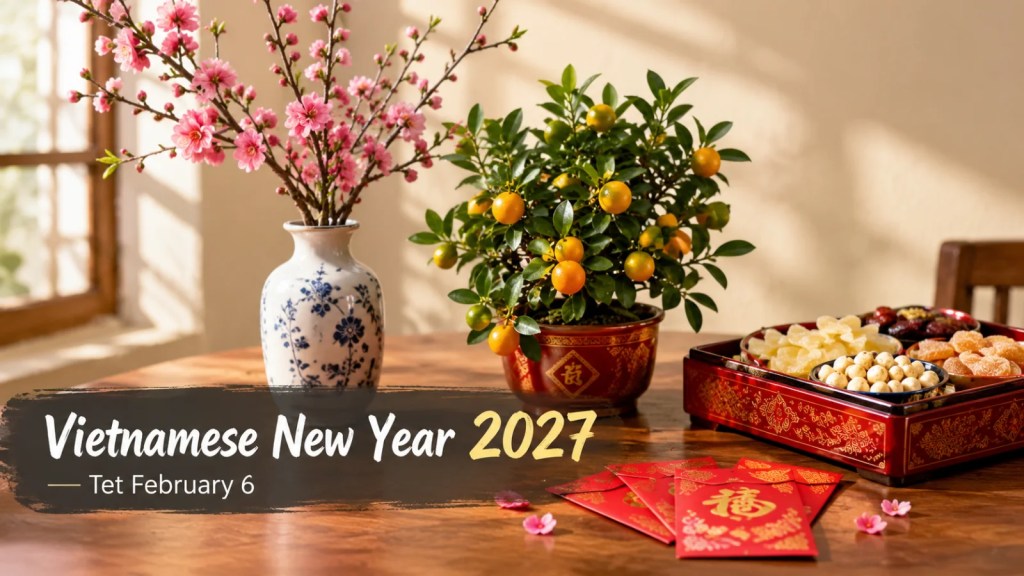
Last updated: October 29, 2026
Vietnamese New Year, known as Tet, is the biggest and most emotional celebration in Vietnam. It is also the one week that can completely change how your trip works. Some shops and stalls close, trains sell out, and big cities go quiet as millions of people head home to their families. Yet for travelers who plan well, Tet is one of the most memorable times to experience Vietnamese culture up close.
This guide explains when Tet 2027 happens, what is open and closed, how prices and transport change, which visa rules apply, where to go, and how to behave respectfully. All dates and rules below were checked in October 2026, but always confirm details before you book.
What Is Vietnamese New Year (Tet)?
Tet Nguyen Dan, or simply Tet, is the Vietnamese New Year and the country’s most important holiday. It follows the lunar calendar and marks the first day of the new year, when families come home, honor their ancestors, share special food, and wish each other luck. The greeting you will hear everywhere is “Chuc mung nam moi,” which means Happy New Year.
Many travelers search for “Happy Chinese New Year in Vietnam” because Tet falls on the same day as the Chinese festival. But Tet has its own food, flowers, customs, and meaning. In Vietnam it is not a tourist event. It is a deeply personal family holiday, which is exactly why so many businesses close.
When Is Vietnamese New Year 2027?
Vietnamese New Year 2027 falls on Saturday, February 6, 2027, and starts the Year of the Goat. The official break for civil servants and public employees is seven days, from February 4 to 10, with work resuming on February 11. Private companies set their own schedules, so the length of the break can differ from one workplace to another.
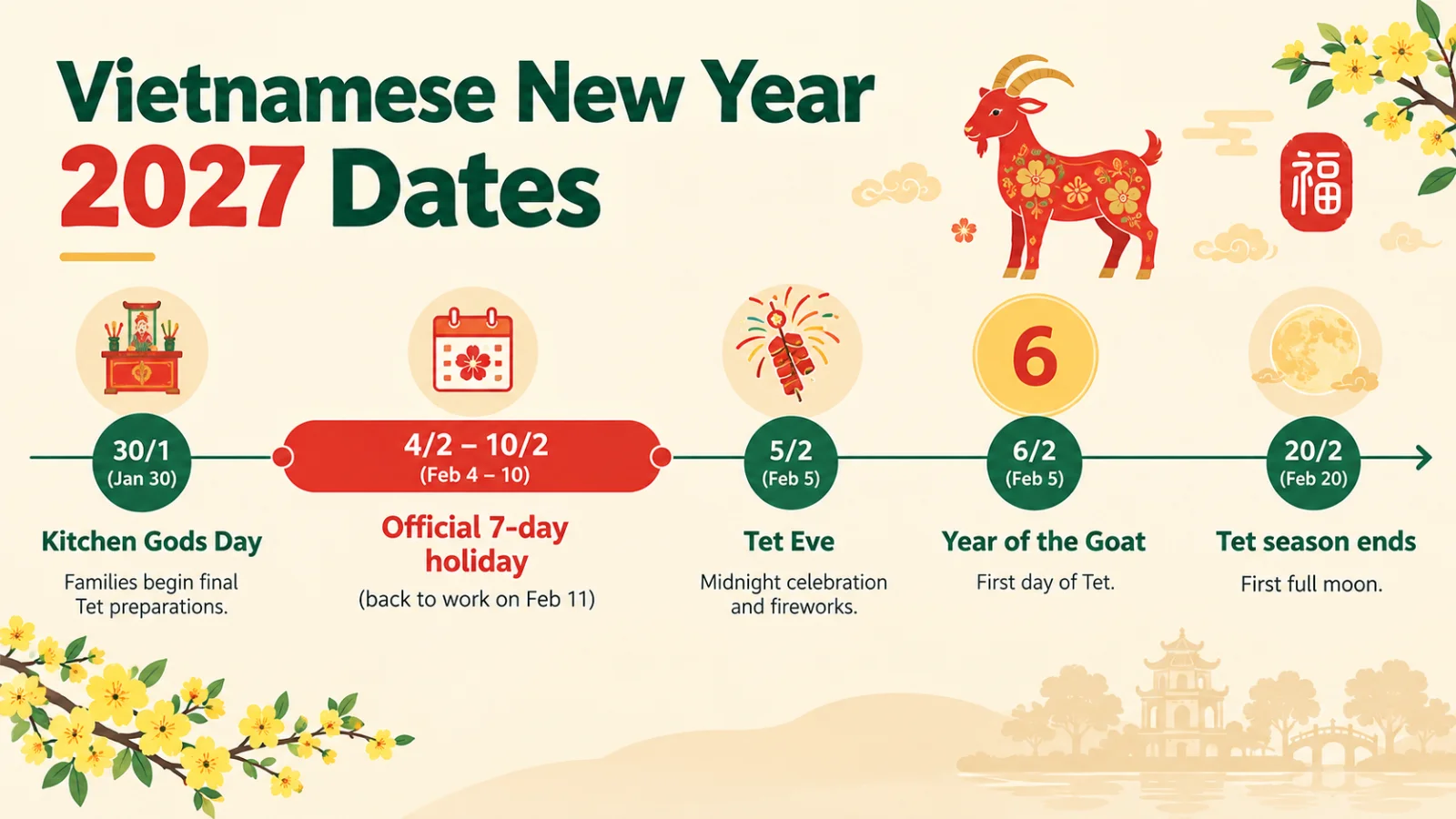
Tet 2027 comes about eleven days earlier than Tet 2026, which fell on February 17, so check your calendar if you traveled for Tet last year.
Key dates for your planning:
| Date | What happens |
| January 30, 2027 | Kitchen Gods Day: families begin final Tet preparations |
| February 4 to 10, 2027 | Official 7-day public holiday (back to work on February 11) |
| February 5, 2027 | Tet Eve: midnight celebration and fireworks |
| February 6, 2027 | First day of Tet, Year of the Goat |
| February 20, 2027 | First full moon: the Tet season ends |
Should You Visit Vietnam During Tet? Pros and Cons
Whether Tet suits your trip depends on what you want from it. The holiday is calm, colorful, and full of tradition, but travel costs more and the first day is very quiet.
Go if you care more about atmosphere than a full schedule, you can base yourself in one or two cities, and you do not mind eating a few dinners at your hotel.
Skip it if this is your first week in Vietnam and street food tours are the main reason you came, you need to cover four or more cities, or your budget is tight. You will pay more for the same room and the same flight.
Still, Tet is one of the most rewarding times to be in Vietnam. Prices climb quite a lot, but you see the country during its biggest festival of the year. If you dislike crowds and noise, do not want to pay more, or cannot stand awkward transport, visit at another time of year. Just know that a trip during Tet will not feel like any other season.
What’s Open and Closed During Vietnamese New Year
Not everything shuts down, and it depends on the city. The first day of Tet (February 6) is the quietest, and many places reopen from the second day. Small family eateries and street vendors are the most likely to stay closed, because owners want to be with their families and holiday wages are high.
| Place | Open during Tet? | What to know |
| Government offices, embassies | Closed | Usually the whole holiday |
| Banks and money exchange | Closed | Get cash before Tet Eve |
| Street vendors, small family-run eateries | Often closed | Many reopen from day 2, a few stay shut longer |
| Restaurants, cafes, and shops in tourist areas | Mostly open | Day 1 is the quietest, most are back on day 2 |
| Main sights in tourist areas | Open | They keep welcoming visitors, but check opening hours |
| Mid-range and upscale hotels | Open | Higher prices, limited menus |
| Convenience stores, fast-food chains | Open | Mostly in big cities |
| Airports and beach resorts | Open | Busy and expensive |
| Major pagodas and temples | Open | Very crowded |
Hoi An and other tourist towns. Life goes on much as usual here. Restaurants, shops, and tailors in Hoi An stay open, and only some small stalls and street vendors take a break. The first day of Tet is the quietest, and most places are back by the second day.
Practical tip: Stock up on snacks and water before Tet Eve, carry enough cash for 5 to 7 days, and book hotels that include breakfast and have an on-site restaurant.
Visa and Entry Requirements During Tet
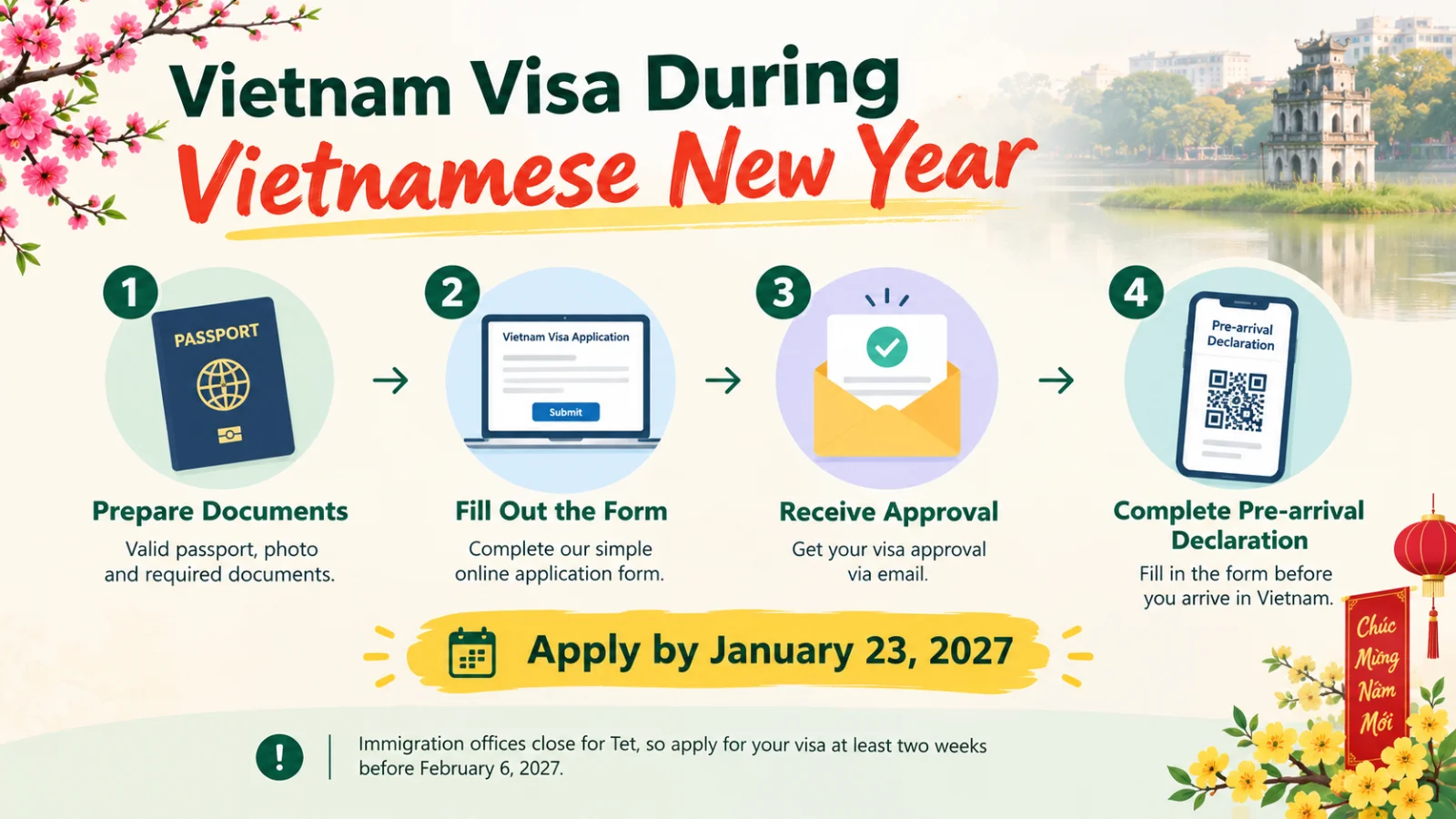
Government offices, embassies, consulates, and the immigration authorities that approve visas all close for the Tet holiday, so visa processing slows or stops for several days. Apply for your visa at least two weeks before February 6, 2027 (by about January 23) to be sure it arrives in time. If you are close to Tet and still have no visa, consider an urgent (rush) visa service.
- Visa exemption: Some countries have bilateral or unilateral visa exemptions with Vietnam. Check your passport on the Vietnam visa requirement checker.
- E-visa or visa on arrival (VOA): If you are not exempt, apply for an e-visa or VOA at Our Vietnam Visa Services. The Vietnam e-visa is the better choice because it is more convenient at the airport. The same service also offers urgent visas for travelers who have no visa yet, and it operates throughout the Tet holiday.
- Passport: Make sure your passport is valid for more than six months after your arrival date.
- Children: A child with their own passport needs their own visa.
- At immigration: Show your passport and your e-visa or approval letter. If you use VOA, also bring a 4 x 6 cm photo and the NA1 entry form.
- Online pre-arrival declaration: Foreign visitors must also fill in the free online pre-arrival declaration at prearrival.immigration.gov.vn before arrival, up to 72 hours ahead, and show the QR code at immigration. It has been required at Ho Chi Minh City (Tan Son Nhat) airport since April 15, 2026, and at Phu Quoc airport since June 1, 2026, and it is being extended to other checkpoints, so check whether your arrival airport requires it.
What we saw during Tet 2026. Tet 2026 fell on February 17, and our team handled nearly 100 urgent visa applications around that time. The fastest was done the same day: submitted in the morning, approved in the afternoon. Almost every urgent customer had either forgotten to apply or applied too close to their arrival date to get a result in time. Apply early so your application is not stuck among the thousands waiting for approval in the days before Tet.
Transportation During Vietnamese New Year
Transport is the hardest part of a Tet trip. Flights, trains, and buses fill up early and fares can roughly double, so a little planning goes a long way.
- Book early. Reserve domestic flights and trains as soon as tickets are released, ideally in November or December 2026, and no later than early January.
- Avoid long journeys on the peak days. The days just before Tet (roughly February 3 to 5) and the days after the holiday are the hardest. Millions of people rush back to their home provinces before Tet and return to the cities to work afterward, so flights, trains, buses, and highways are extremely crowded on these days.
- Choose the right direction. Flights from the North to the South tend to be less crowded before Tet, and South to North after the holiday.
- Limit the number of destinations. Two or three bases make much more sense than a tour of the whole country.
- Use ride-hailing wisely. Grab and taxis still operate, but fares can be double or higher, and fewer drivers are on the road. Short city trips are fine.
- Arrange airport transfers ahead. Ask your hotel to book a car for arrival and departure days.
- Consider a private driver for the days when public transport is full.
Real price examples. These come from our own price checks, so use them as a guide and check current prices before you book.
| Item | Normal day | During Tet |
| Hanoi to Da Nang, one-way Vietnam Airlines flight with 20 kg checked bag | About 1.2 million VND | 2.5 million VND on February 7, 2027 (about double) |
| Grab from Ho Chi Minh City airport to District 1 | About 5 to 7 USD | About double on Tet Eve, and cars are much harder to find |
Why fares jump around Tet. Millions of people want to travel home at the same time, so planes, trains, and buses fill up days in advance and airlines sell the last seats at higher prices. The same thing happens in reverse when everyone returns to work. Many drivers also stay home for Tet, so fewer Grab cars serve many more passengers.
Hotels, Restaurants and Tours During Vietnamese New Year
Hotels stay open during Tet, though rooms cost more and tours run on a lighter schedule. Here is how to plan around it.
Hotels. Hotels do not close for Tet, but prices rise, and not equally everywhere. Beach and resort destinations such as Nha Trang, Da Nang, Phu Quoc, and Ha Long see the biggest jumps. Ho Chi Minh City and Hanoi change much less because they have so many hotels. For example, a double room (27 m², 2 guests, buffet breakfast included) at Liberty Central Nha Trang Hotel in the city center costs about 35 USD on a normal day and 103 USD during Tet, almost three times more. Always confirm that your hotel will be staffed and that breakfast is served on the first days of Tet.
Restaurants. Plan on eating at your hotel on Tet Eve and the first day of the year, which are the quietest. Many hotels hold special Tet menus or dinners. From the second day, most restaurants and cafes in tourist areas are back in business, and convenience stores and larger malls are open throughout.
Tours. Larger tour operators run limited departures, and many local guides take time off. Book any cooking class, food tour, or day trip in advance, and ask for written confirmation that it will run on your date. Some tours, such as cruises or city culture tours, can be better value at this time of year because the roads are quiet.
Best Places to Visit in Vietnam During Tet
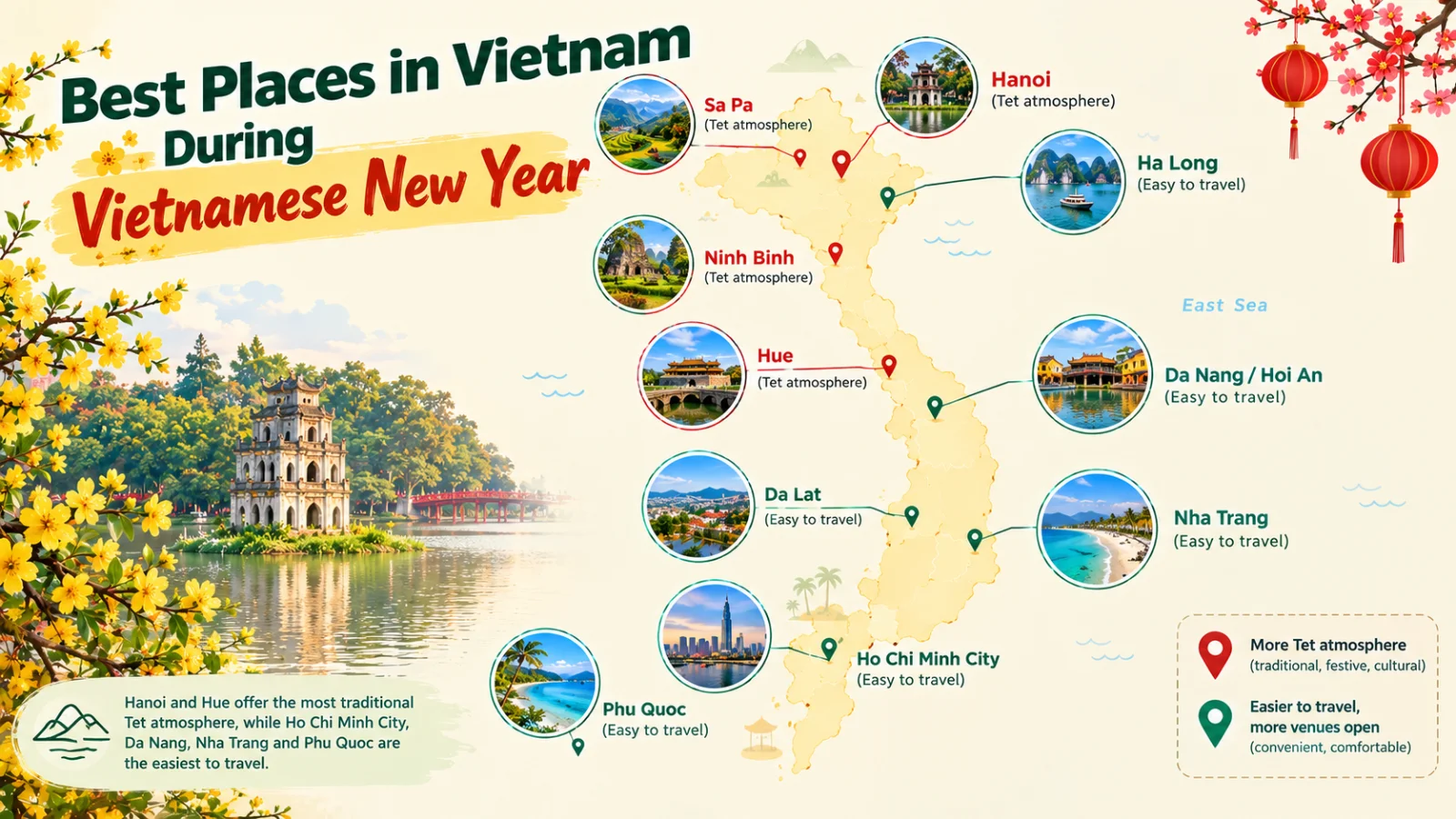
Where you go matters more at Tet than at any other time. Ho Chi Minh City, Da Nang, Nha Trang, and Phu Quoc are the easiest because hotels, beaches, and malls keep running, while Hanoi and Hue give you the most traditional Tet atmosphere.
Hanoi, Ha Long Bay, Sapa, Ninh Binh
Hanoi is the most traditional place to feel Tet. Walk through the Old Quarter and the flower markets before Tet Eve, watch the midnight celebrations around Hoan Kiem Lake, and visit the Temple of Literature, where calligraphers write wishes for the new year. Nearby, Ninh Binh offers peaceful scenery and large pagodas, and Ha Long Bay remains accessible, although some cruises reduce departures. Sapa is a good choice if you enjoy mountain scenery.
Hoi An, Hue, Da Nang
Central Vietnam is a good compromise. Hue’s Imperial City hosts traditional Tet decorations and activities, and the old streets are calm and photogenic. Hoi An’s lantern-lit Ancient Town stays open for visitors, and its restaurants, shops, and tailors operate as usual, apart from some small stalls and street vendors. The first day of Tet is the quietest, and most places are back by the second day. Da Nang is a modern, open city with beaches and large hotels that stay active.
Ho Chi Minh City
Ho Chi Minh City normally has around 10 million people living and working in it, and during Tet only about 2 to 3 million stay. The streets are calmer and less crowded than usual, but services and amenities are still available. The main highlight is the Nguyen Hue Walking Street Flower Festival, a large display of flowers and decorations that draws families for photos. Large hotels, malls, and many rooftop venues remain open.
Nha Trang, Da Lat, Phu Quoc
Beach and highland destinations are a smart choice for visitors. Nha Trang and Phu Quoc offer sunshine, open resorts, and a relaxed atmosphere. Da Lat is cooler and famous for flower gardens, and it is popular with domestic travelers, so book early. These areas are busy with Vietnamese holidaymakers, so expect higher hotel rates but plenty of open restaurants.
Weather in Vietnam During Tet
February is the cool, dry season across most of the country, but the gap between north and south is wide, often 10 degrees or more on the same day. The table below uses rounded monthly averages for the whole day and night, so treat it as a guide rather than a forecast.
| Region | Typical range | What to wear | Good to know |
| Hanoi, Ninh Binh, Ha Long Bay | About 14 to 21°C | Light jacket, sweater, rain layer | Gray skies and drizzle, a little colder on the bay |
| Sapa | About 3 to 14°C | Warm coat, thermal layers | Fog, and frost is possible |
| Hue | About 18 to 25°C | Light jacket for evenings | Cloudy with some rain |
| Da Nang, Hoi An | About 20 to 26°C | T-shirt plus a thin layer | A few showers |
| Da Lat | About 12 to 24°C | Hoodie or jacket | Sunny days, cold nights |
| Nha Trang | About 22 to 29°C | Beachwear | Mostly sunny, sea around 26°C |
| Ho Chi Minh City | About 23 to 33°C | Light cotton, sun protection | Dry and hot, strong sun |
| Phu Quoc | About 24 to 31°C | Swimwear | Dry season, sea around 28°C |
During a cold snap Hanoi can feel closer to 10°C, so check the forecast a week before you fly. If your trip crosses regions, pack thin layers you can add or remove rather than one bulky coat.
Sample 7-Day Itinerary for Vietnam During Tet
This plan spends Tet Eve and the first day of Tet in Hanoi, then takes one short flight to Da Nang and Hoi An for beaches and lanterns, so you travel as little as possible on the busiest days.
| Day | Date | Where | Plan |
| 1 | Thu, Feb 4 | Hanoi | Arrive and check in. Walk the Old Quarter and the flower markets. Buy cash and snacks. |
| 2 | Fri, Feb 5 (Tet Eve) | Hanoi | Visit the flower markets in the morning, rest in the afternoon, then join the midnight celebrations around Hoan Kiem Lake. |
| 3 | Sat, Feb 6 (Tet Day 1) | Hanoi | Visit pagodas and the Temple of Literature. Many shops are closed, so eat at your hotel. |
| 4 | Sun, Feb 7 | Hanoi to Da Nang | Take a pre-booked flight to Da Nang. Walk on My Khe Beach in the evening. |
| 5 | Mon, Feb 8 | Hoi An | Explore the Ancient Town and see the lanterns at night. Most restaurants and shops are open, so you can eat and shop as usual. |
| 6 | Tue, Feb 9 | Da Nang | Relax at the beach or visit the Marble Mountains. Eat at hotels and malls. |
| 7 | Wed, Feb 10 | Da Nang | Go to the airport early. Return crowds are heavy on the last day of the holiday. |
With only 5 days, drop Days 6 and 7 and fly home from Da Nang on Day 5. Book flights and hotels as early as possible, because this plan uses the busiest travel dates.
Vietnamese New Year Traditions Travelers Will See
Tet is full of small rituals, and most of them are about luck, family, and a fresh start. These are the ones you are most likely to notice as a visitor.
In the week before Tet, households prepare as if an important guest were about to arrive. Around a week ahead, families make offerings to send the Kitchen Gods to heaven, scrub the house from top to bottom, and fill it with flowers: peach blossoms in the North, yellow apricot blossoms in the South and Center, and small kumquat trees everywhere. Motorbikes piled high with blossoms and kumquat pots are a common sight on the streets.
On Tet Eve, everything builds toward midnight, the moment called Giao Thua when the old year turns into the new. Families gather around the ancestor altar with fruit, incense, and food, and many cities set off fireworks. Standing among the crowd at a lake or a pagoda gate at this hour is the closest a visitor gets to the heart of the holiday.
In the first days of the year, people visit relatives and temples. Children receive lucky money (li xi) in red envelopes. The first person to step through the door (xong dat) is believed to set the family’s luck for the whole year, so hosts often invite someone they trust. Lion and dragon dances at temples and public squares are meant to drive away bad luck, and in places such as Hanoi’s Temple of Literature, calligraphers write New Year wishes on red paper.
Foods to Try During Vietnamese New Year
If you try only one Tet dish, make it banh chung (bánh chưng), a sticky rice cake filled with pork and mung beans. Tet food is meant to be shared with family, and many dishes can be tried in hotels or at special restaurants.
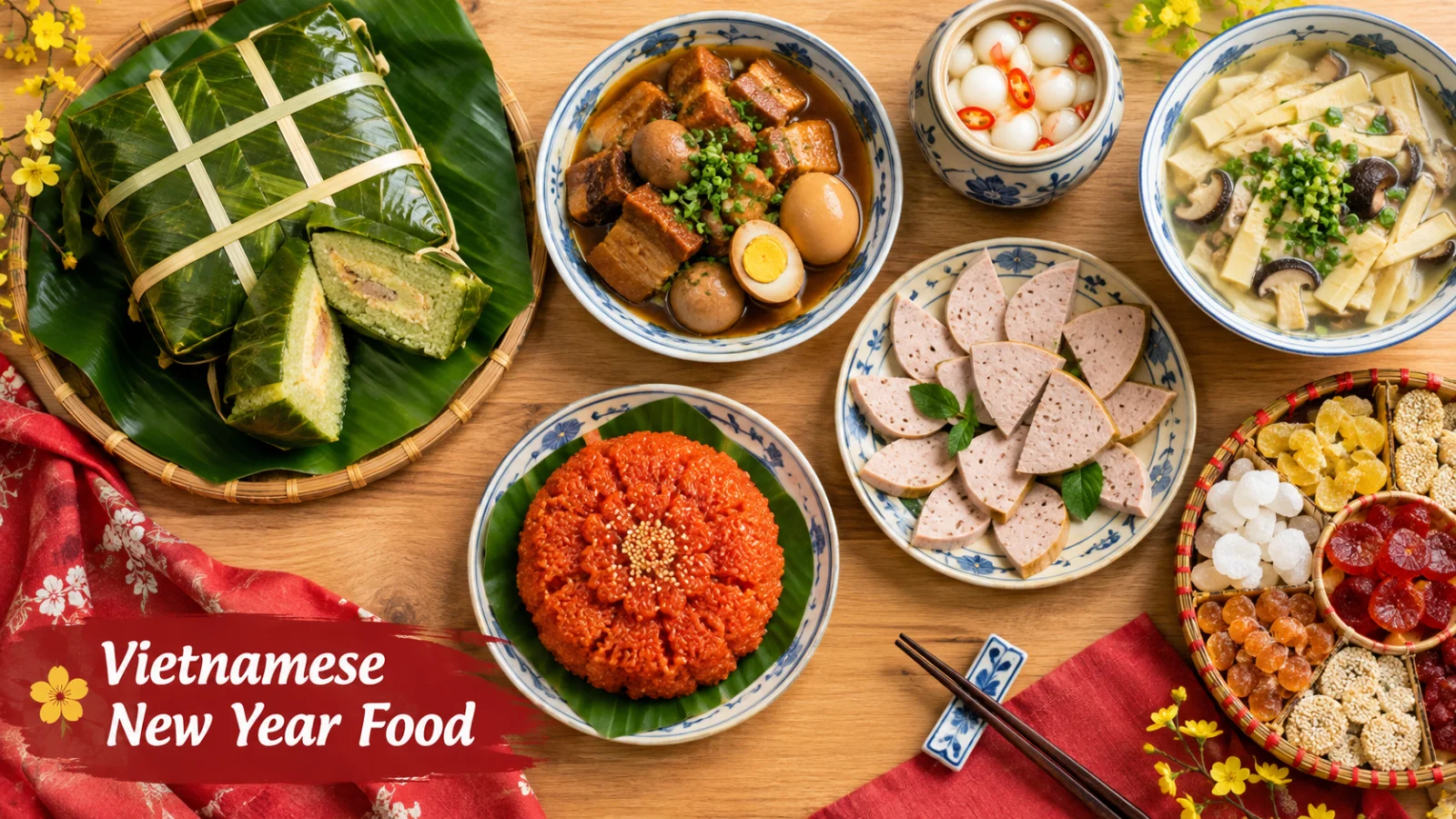
| Dish | What it is | Why it is on the Tet table |
| Banh chung and banh tet | Sticky rice cakes with pork and mung bean, wrapped in leaves and boiled for hours. Banh chung is square (more common in the North), banh tet is a log shape (more common in the South) | The signature Tet food, eaten and given as a gift |
| Thit kho | Pork and eggs braised in a sweet and salty sauce | A rich Southern family dish, eaten with rice and pickles |
| Gio cha | Vietnamese pork sausage, sliced | A staple of celebration meals |
| Dua hanh | Pickled onions | Their sourness balances the heavy dishes |
| Canh mang, canh kho qua | Bamboo shoot soup and stuffed bitter melon soup | Traditional family soups at the Tet meal |
| Mut Tet | Candied coconut, ginger, lotus seeds, and other fruits | Served with tea to every guest who visits |
| Xoi gac | Sticky rice colored red with gac fruit | The red color stands for luck |
If a family invites you to the table, taste a little of each dish and thank them for each offer. Refusing everything can come across as impolite.
Vietnamese Traditional Clothing in Tet
The traditional Tet outfit is the ao dai (áo dài), a long, close-fitting tunic worn over pants. Red, yellow, and other bright colors are popular because they stand for luck and joy.
Both women and men wear ao dai at Tet. Men may also wear the ao gam, a traditional tunic, for formal photographs. Families often take portraits in front of flowers and decorations, and photo studios are fully booked.
As a visitor, you can rent or buy an ao dai in cities such as Hanoi, Hue, and Ho Chi Minh City. Book a fitting early and avoid the first day of Tet, when most shops are quiet.
Tet Etiquette: Do’s and Don’ts for Foreigners
A few small gestures go a long way at Tet. Greet people warmly, dress neatly, and be gracious if you are invited into a home. Here is how that plays out in practice.
If you are invited into a home. Bring something small, such as fruit, tea, or sweets, and hand it over with both hands. Take off your shoes if your hosts do, accept the tea and snacks you are offered even if you only take a bite, and ask before photographing the family altar. Unless the family has asked you to, avoid being the very first person through the door on New Year’s Day, because the first visitor is believed to shape the household’s luck.
In pagodas and public places. Dress neatly with shoulders and knees covered, keep your voice low, and ask before photographing people who are praying. Do not step on temple thresholds or point your feet toward an altar.
What to wear and bring. Bright colors, especially red and yellow, suit the mood. Skip all-black or all-white outfits, which are associated with mourning. If you are close to a family, small red envelopes with new banknotes are a kind gesture for their children. Avoid giving knives, scissors, or clocks as gifts.
Tone and timing. Greet people with “Chuc mung nam moi,” stay calm, and avoid arguments or gloomy topics in the first days of the year, since the mood you start the year with is believed to follow you. Do not expect normal service on the first day, and be patient with delays.
Your Tet 2027 Preparation Timeline
Working backward from February 6 makes the whole trip easier. This is when to do each thing.
| When | What to do |
| November 2026 | Book domestic flights and trains as soon as tickets are released |
| December 2026 | Book hotels, especially in Nha Trang, Da Nang, Phu Quoc, and Ha Long |
| By January 23, 2027 | Apply for your visa, at least 2 weeks before February 6 |
| February 3, 2027 | Withdraw cash and buy snacks and water before shops and banks close |
Conclusion
Visiting Vietnam during Tet 2027 is a trade-off. You will see the country at its most traditional and festive, with calm cities, flowers everywhere, and families celebrating together. In exchange, you must accept a few closures, higher prices, and crowded transport.
The key points to remember: Tet falls on February 6, 2027; the official holiday runs February 4 to 10; book flights, trains, and hotels as early as possible; carry cash; apply for your visa at least two weeks before February 6; and choose a base where the atmosphere and open venues match your plans.
Plan carefully and travel with an open mind, and Tet may turn out to be the most rewarding week of your trip. Chuc mung nam moi!


You must be logged in to post a comment.